Hello everybody!
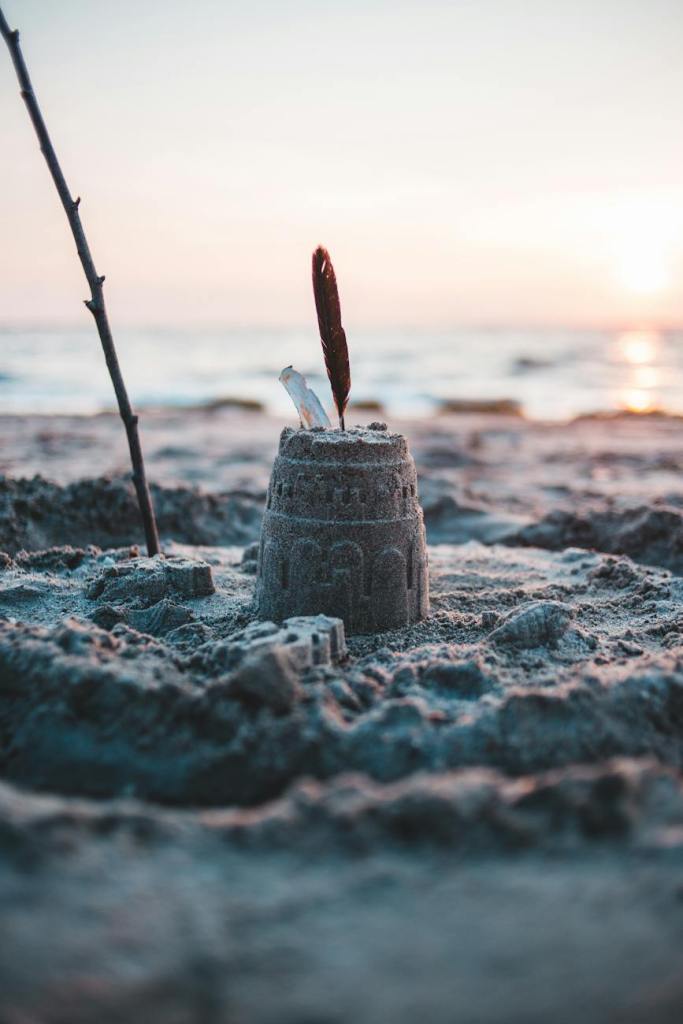
In my last post I took a peek at sand as a souvenir. Many of us collect sand from beautiful places that we visit or vacation in. It’s a different kind of connection we make to such places. We tend to romanticise them and it’s only natural that we like to bring back a keepsake, a literal little piece of the place. Back home our friends might wonder about our handful of sand. Let’s face it, it’s not the most visually appealing memento in the world. The beauty of it is in our minds instead, in our memories and the associations we make. It’s a very personal and subjective thing. In this second sandy post I want to take an objective look at sand.
What is sand? Where does it comes from? Your bit of sand has its own fascinating story, it’s just that most of us are oblivious to it, because we suffer from a special kind of illiteracy. Geologists and geomorphologists can read the landscape and boy am I ever envious!
We all know that what goes up must come down. It’s so fundamental that we figure this out before we’ve learnt a language to express it in, nevermind Newton’s elegent mathematics or the folkloric apple that fell on his head. It turns out, unsurprisingly, that this truism also applies to the Earth itself. Let’s take the classic example of mountains. To us mayflies they seem the very embodiment of permanence. How many empires have raised themselves up and crashed down like little ocean waves along the flanks of the unchanging Taurus Mountains, the Caucasus, the Alps or the fearsome ranges along the Silk Road? But if we could take a look at them in geological time, they come and go like everything else, no more permanent than the sandcastles of human children.
Now the point of this is not to make you feel insignificant – although we are – and certainly not to inspire an existential dispair. My intention is rather to hint at the amazing history of a grain of sand, at the larger story it is a part of. Once a mountain range has been weathered to sand and silt and washed out to sea, that’s not the end of it. Sure, one very epic leg of the journey is thus ended, but that same grain of sand also represents the beginning of another, no less epic sequel. Along with untold gazillions of other sedimentary particles, it will be buried and cemented together, lithified into stupendous slabs and layers of sedimentary rock, which, millions of years later may be thrust and faulted and folded by plate tectonic forces into new mountains. It’s a cyclical story called the rock cycle.
Your little bottle of sand is therefore a small sample representing a snapshot of a particular place, how it is connected to the rest of its watershed and the processes continuously operating within it. And it’s also a single snapshot in time of an unfathomably huge and repeating cycle of becoming and coming-undone, the yin-yang of sand and rocks I alluded to in my previous post.
I’m not sure what this knowledge does for your collection of sand. If you’ve some sand souvenirs from wherever for whatever personal reasons, does having the merest inkling of the mind-boggling processes and histories of the physical planet we live on make them more special to you? Or maybe less? Your own associations and memories are still there, they’ve just been added to, is all. There are many layers of meaning to sand, as there are to most things.
Wishing you happy explorations. May we stand in awe a bit more often at the amazing planet we walk about on.
 The Insane Coffee Project
Leave a comment