Hello friends!
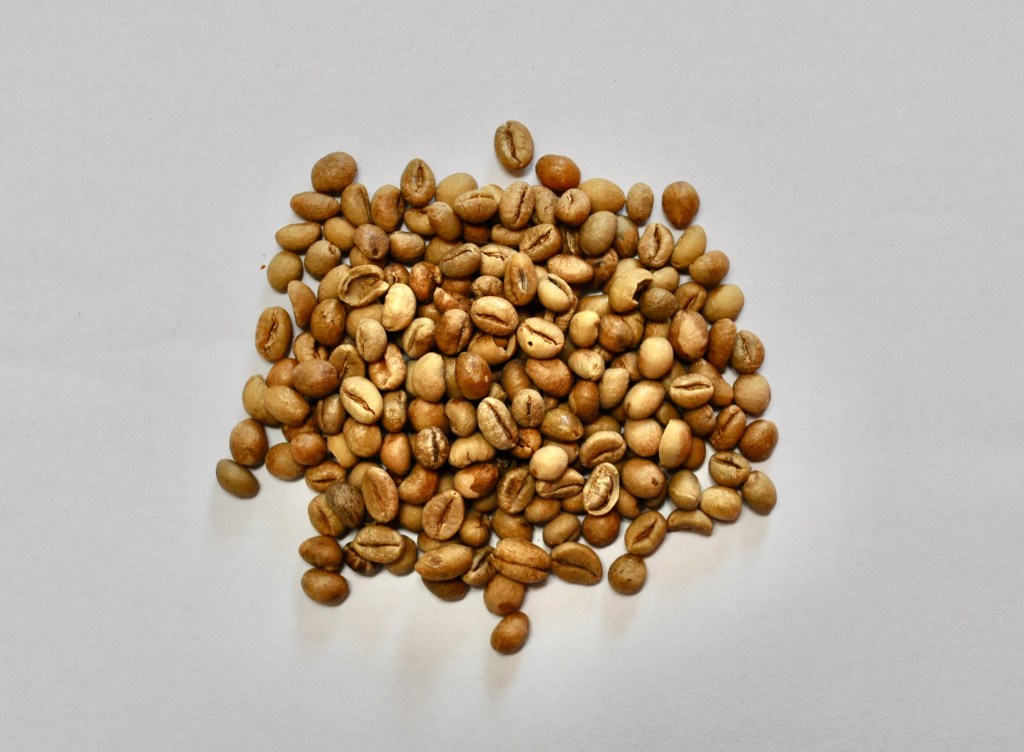
I want to share with you one of the most disgusting coffees I have ever come across. Chances are good that it’s the most disgusting, period. And by sharing I mean a picture of these beans and the story behind them. (Will we one day have the technology to share taste profiles digitally? I’m not keeping my fingers crossed. It’s not the only objection, but being able to arbitrarily copy and widely share the taste of these here beans would be a clear instance of dystopia!)
To readers who don’t live in a rabbit hole of coffee, the beans you see pictured are green, unroasted ones. Coffee beans are the seeds of a coffee plant. This is what they look like after they’ve been removed from the fruit flesh surrounding them, and dried. Before coffee beans can be used to make ourselves a cuppa with, green beans need to be roasted. Mostly this is done on industrial-scale roasters, but many smaller machines for home use are now on the market. I use one myself. It’s a fun hobby and you’d be amazed by a world of fresh flavours! I paid tribute to roasting in a previous post about fire.
Another short aside: the spirit of this post is not meant to be negative, about bashing a particular coffee or growing area. Honestly not. I’ll return to this briefly at the end of the post.
I bought these bad boys in the Blue Souk in Sharjah, in the United Arab Emirates. I randomly asked one of the many sellers of tea and spices if he had any coffee. “Of course, of course,” came the answer. He beckoned me to the back of his stall, where lighting from the florescent tubes out front were reduced to a twilight, and dipped his hand into a little jute bag. “Only the best, my friend, only the best,” he assured me. “Yemeni beans.“
You should know that Yemen produces some remarkable coffees, which is all the more surprising because that is the last thing you’d expect the climate on the Arabian Peninsula to be good for. They’re tiny beans but packed with unusual spicy flavors. Yemen was also the first country to commercially grow coffee after the seeds were brought there from their native East Africa around 1500, and most of the rest of the world’s coffees is derived from this stock.
Back in the Blue Souk, I had my reservations about the poor wee bastards of beans that the merchant presented to me. My friend Omar, who was showing us around, also looked skeptical. “Dude, it’s probably just from Iran,” he said to me. And looking across the Persian Gulf from Sharjah, you can see Iran. But I decided to buy a little baggy anyway. Just because I’d probably never return to Sharjah or the Blue Souk. And when or where else would I get the opportunity to bag me some Iranian beans? Yes, they would taste predictably horrible, but their very existence is a testament to the stubborn willpower with which a sad few coffee beans can be squeezed out of a landscape and a climate exceedingly unsuited to doing so.
And now, the $0.99 question: how did they cup? (This is coffee industry jargon for “what did they taste like?”)
These Iranian beans were tiny as premature joeys, many of them broken. They looked like ingrown toenails and tasted of burnt rubber, with a shoulder of fermented yak milk.
They tasted so offensive that I only ever roasted one tiny batch of it. What was left is what you see in the photograph above, all 34 grams of (the unroasted horror of) it. I bought these green beans in the Blue Souk 15 years ago. Although green coffee can be stored for much longer than roasted coffee before going bad, you cannot do so indefinately. But I daresay these beans break that mould. Taste-wise, I cannot imagine these suckers tasting any worse after a century of “maturing” than they did fifteen years ago.
Although they would make the perfect coffee to sit on your veranda and watch the world end with – assuming that that’s a fast affair – I have no intention of ever roasting them. That is absolutely unique in my history of drinking coffee and in my collection hobby of spent coffee grounds.
I stand in awe of what has been achieved here. And I say that quite sincerely.
The world of coffee is a very diverse one. I never would’ve thought so when I was much younger, mindlessly swilling one instant coffee after another. But once I discovered really good coffee, I was amazed at the diversity of everything that discovery led to. And why only celebrate the coffees at the yummy end of the spectrum? In a recent post, I wondered whether life is like a cup of coffee. I steered clear of answering either yes or no, but there are certainly many parallels. Let’s face it, life can sometimes suck. And some cups of coffee are gonna do likewise. If they didn’t, how would you know how good the good bits are?
The taste of these coffee beans do not reflect negatively on Iran, if that is even where they are from, but let’s assume for the sake of argument that they are. That would be as absurd as slamming Iceland for the poor quality of its (hopefully non-existent) wine.
If you’d like to read about some other highlights of my collection, you can do that here. Most of them were not chosen for how great they tasted, but rather for the unusual stories of where they came from. I didn’t even know of the existence of some of those places before I discovered them directly through coffee.
Thanks for reading! I hope you enjoyed it.
 The Insane Coffee Project
Leave a comment