Part I
[If you are a member of Medium and would like to support my writing financially, please read this story here.]
People are tremendous talkers.
What I mean has nothing to do with the introvert-extrovert spectrum. I believe that all of us are tremendous talkers. Even us introverts speak a lot, regardless of how shy we may be around other people.
For starters, we all talk to ourselves. It’s called the internal monologue, our ongoing commentary to the stream of consciousness that we live and move in.
As children we talk to animals and plants, to our teddy bears, to imaginary friends. Most of us are told about God, so we speak to Him as well. Did you ever lie in your childhood bed negotiating with the sandman, tooth fairy or Easter bunny?
Many adults carry on talking to their house plants, their pets, to God. We threaten our obstreperous smart phones, cars and washing machines with all kinds of retribution, out loud and in the most scathing of tones.
It doesn’t have to be out loud. Most people talk to God in their heads, silently. My sister still speaks to our grandmother who passed away more than twenty years ago. (With a name like Hester, you almost have to keep talking to her.)
If we have the gumption to bestow names on all manner of things (which is a requirement of human languages) then we might as well talk to them. Many of these things may be inanimate. So what? People who’re no longer alive? Go on. When it comes to the proposition of an afterlife, your guess is as deaf, dumb and blind as mine is. Perhaps it’s something that never even existed. Why start splitting hairs here?
I suspect that talking to things, especially if it’s done quietly, in our heads, is not so far removed from simply thinking about them. In this view of things, Stephen Hawking sat trapped in his body and wheelchair, talking to black holes. And, in a manner of speaking, they spoke back to him!
Now, that’s top shelf kind of stuff. I only mention it to celebrate exceptionalism. If it can inspire or delight us, that is good, but it should not be a yardstick to measure our own ramblings against.
You can talk to Africa, to the last dodo, or to Rocky Balboa your entire adult life and if you never learn anything new about them in that manner, it would be no skin off anyone’s back. You might learn something about yourself along the way, but if you don’t it would also be fair enough.
Talking doesn’t have to lead to greater understanding. Just listen to most so-called conversations. Small talk is banal and fickle and frivolous, and for all that somehow important.
I must’ve felt an odd pang of jealousy after my sister admitted to me that she still talks to our deceased ouma Hester. And then Paul Kingsnorth converted to Orthodox Christianity. I also want to start talking to a Stranger, I realised. Something that isn’t human (and not an AI either).
My dead relatives were too specific and God too general. I wanted something with permanence and gravitas, but at the same time local.
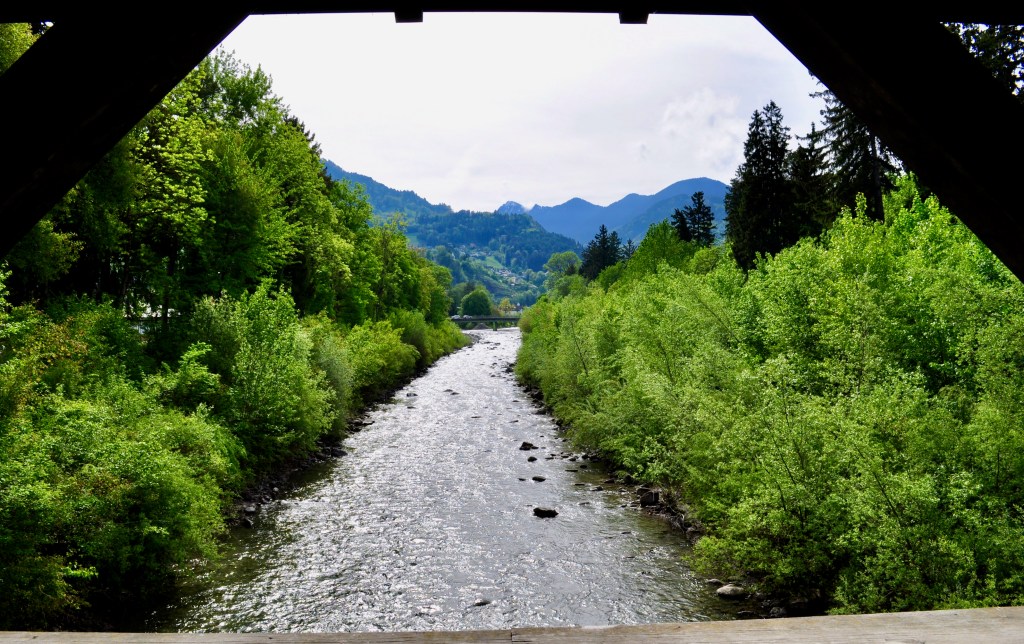
I live close to a small river that drains a V-shaped side-valley before its waters join the Alpine Rhine, which takes them into the Lake of Constance, which eventually takes them into the Rhine proper and onwards toward the North Sea.
We take dips in this river in high summer. Along our reach of it, it’s straight as an arrow. It was made that way with raised earthwork banks. Hydraulic engineering. Beyond these banks there’s a shoulder of riparian forest, a small afterthought for the day when the water rises above that level.
During high water events, I stand in the middle of a covered timber bridge and pour a jar full of coarse spent coffee grounds into the river. A little ritual offering. (I’ll report on this in more detail in a future story.)
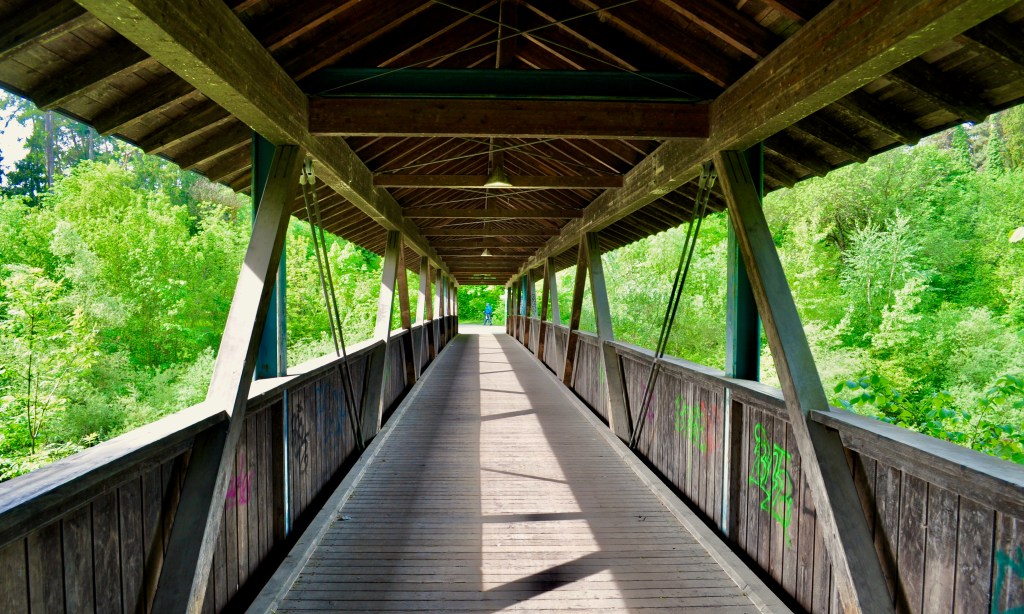
The receding high waters leave behind gifts of driftwood, huge trunks stranded on a freshly deposited armour layer, smaller branches as thick as a rugby player’s thigh, entangled in the vegetated banks, their ends worn smooth as river stones.
I used to daily cycles across the same bridge on my to and from work. Especially in the twilight mornings, I would greet the river and its flanking strip of forest.
“Good morning Frutz!” That’s the name that settlers here bestowed on it nearly a thousand years ago.
In other words, I have been conversing with this river for some time already. Some of it was done with actual human words, like my twilight greeting in passing, more of it was non-verbal. I at any rate now would like to do all of that, and possibly more, in a more mindful manner.
And I will continue to write about my talking to the Frutz. This was an introduction, a sort of preamble that served, as much as anything, to convince myself that it’s okay to talk to a river.
 The Insane Coffee Project
Leave a comment