Introduction
One day in the spring or summer of 2004 I brewed a moka pot and failed to afterwards throw away the spent puck. Almost 20 years later I’m still failing and having a blast with it. I carefully dry and collect the mortal remains of every coffee I make at home. Hence home grounds.
The key to how this unusual hobby started was my discovering single origin beans. When you buy a bag of single origin beans they were all grown and harvested in one particular growing region, sometimes even a single farm. I was simply fascinated at the prospect of trying coffees from so many different places. What would they taste like? How noticable would the differences between them be? Most of those coffees blew my socks off! I wanted to find out more.
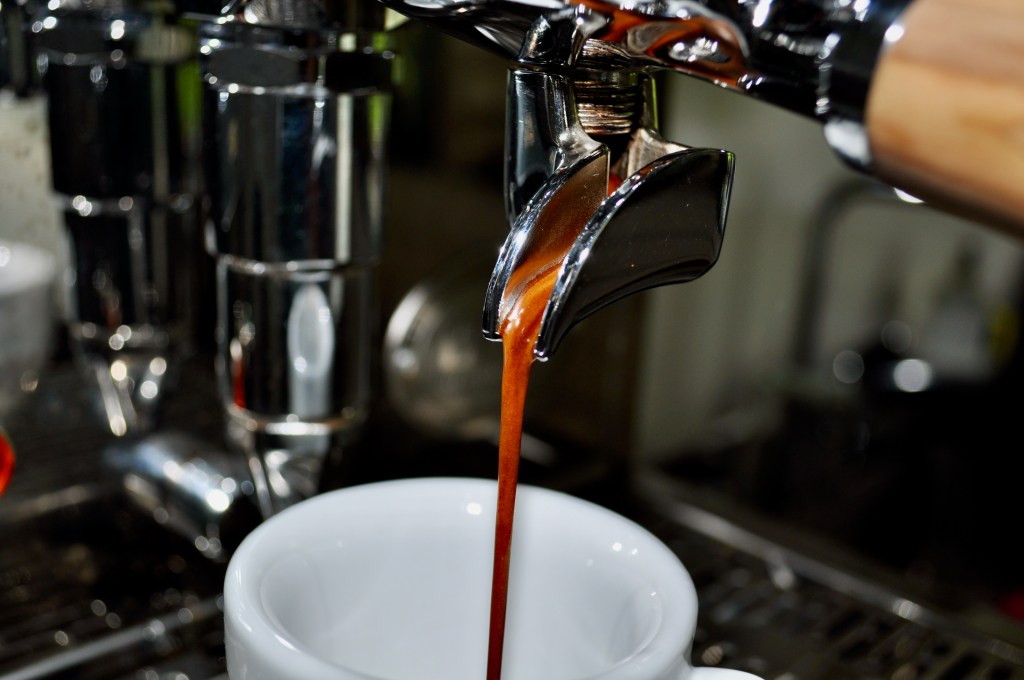
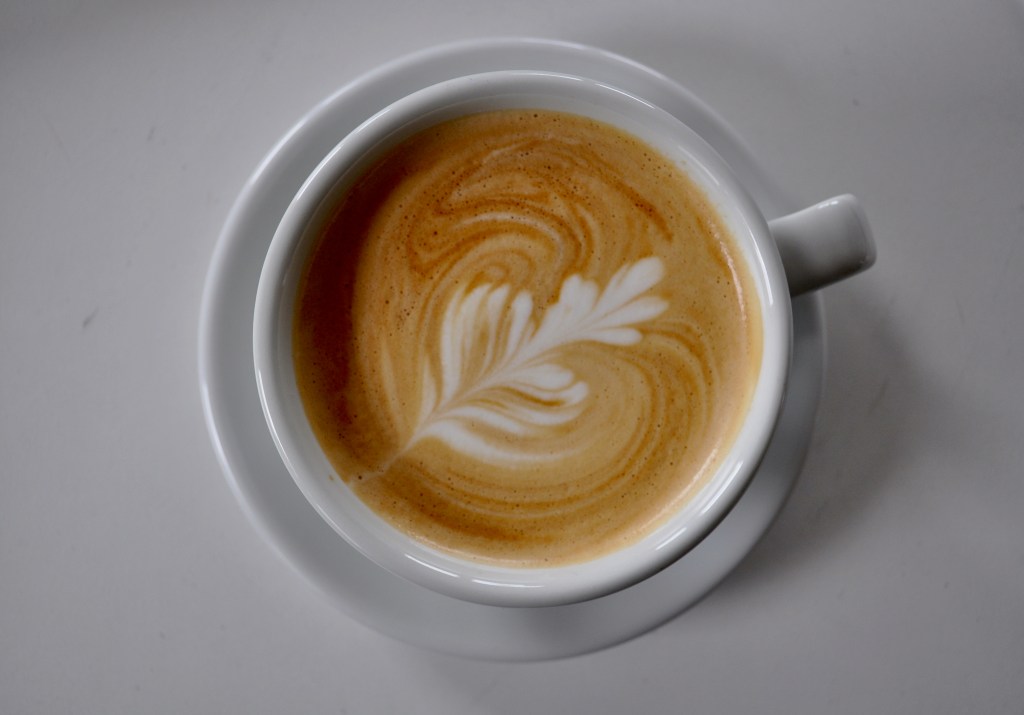
Espresso or cappuccino? On most days I find it too hard to choose and have one of each.
I learned about different growing conditions at different altitudes, came across a great number of varietals, sometimes even the odd species beside the two behemoths (Coffea arabica and Coffea canephora) that dominate the global industry. I learned about different processing methods. That refers to how the coffee seeds are removed from their surrounding layers of mucilage and fruit flesh, and the details of that noticably impacts the taste profiles in the cup. (Lately some incredible coffees are being produced by experimental fermentation techniques, and we’re only on the begining of that journey. It’s very exciting stuff!)
One day I came across a retailer willing to sell me green, raw coffee beans. I jumped at the opportunity and gave roasting them a crack in my kitchen the same afternoon. I did this on a little tin-foil tray in our oven. Looking back at it now it makes my skin crawl, but I went into it blissfully unfettered with any knowledge. Sometimes that can be a great advantage in your life. I also started brewing the freshly roasted beans immediately afterwards. Yes, I would slowly back away from any such beverage today, but at the time I was bowled over by how unexpected it tasted, the weird freshness of it.
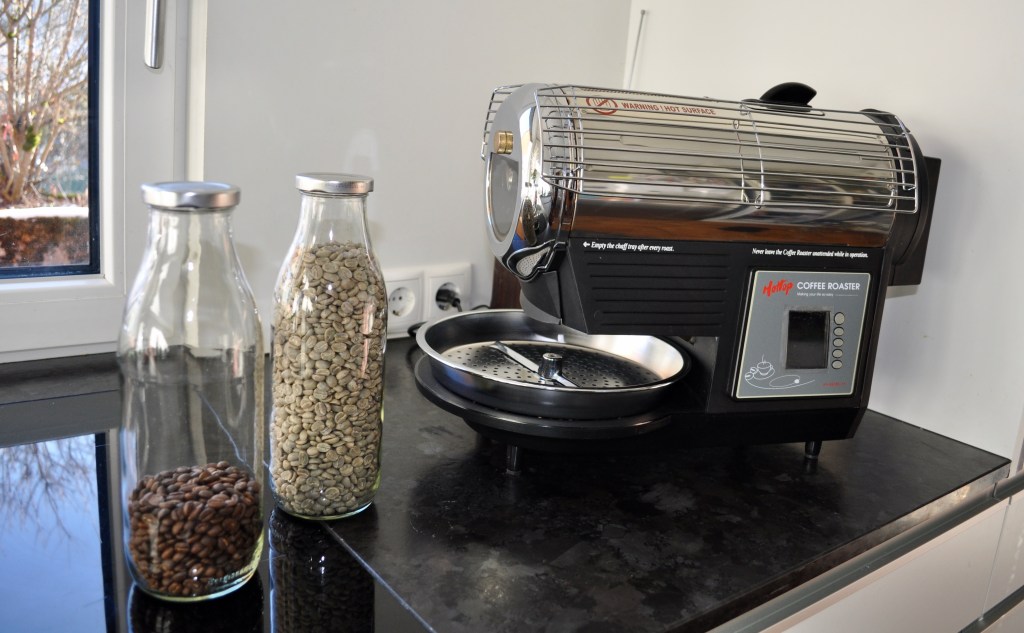
A few years later, I got myself a small home roasted (Gene-Café) and some years after that my current one, a HotTop (pictured above). I’m looking forward to trying different machines in the future and would also relish the opportunity to learn roasting on a larger batch machine. I suspect that roasting coffee is something you can never really master, or better said, you’ll never run out of things to learn about it. And that is a great thing, to be embraced.
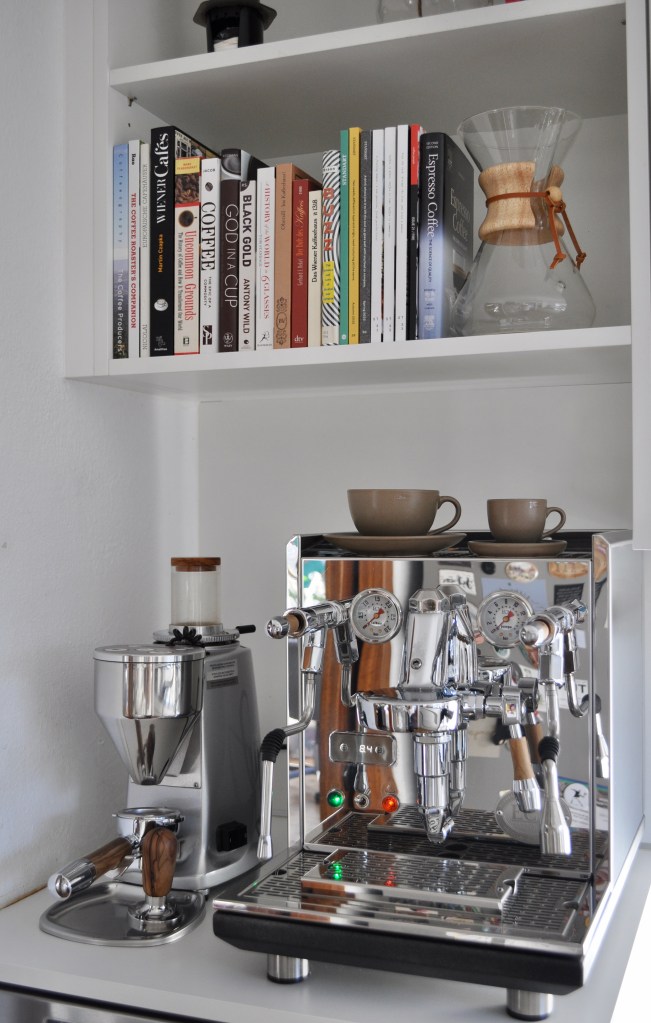
Where the magic happens at home: a Mazzer Mini grinder and ECM Synchronika.
What am I going to do with it?
Coming back to the spent grounds that I collect, everybody wants to know what I’m going to do with it. The assumptions must be that you cannot collect anything this weird without having a specific purpose in mind for them. I’m sorry to say folks, but this stuff is unlikely to hold a future cure for cancer.
For now I’m just enjoying adding to it: discovering and trying and collecting the grounds of new coffees from new places or coffees processed in exciting new ways, coffees with unusual stories behind them. A more immediate focus for me is to also start working in the coffee industry, to make a career out of my passion.
So for now I’m not doing anything with my huge pile of spent coffee grounds. I’m just growing them and enjoying the process. I have a daydream or two about how I would like to one day let them go again. And I do want to let them go. I know that you cannot hang onto things forever. Even a lifetime is too much.
The best solution I’ve come up with is to go bury them in a desert. Earth is a rather wet place and I would like for my grounds to stay as dry as possible – and thus safe from the clutches of fungi – for as long as possible.
Imagine an anthropologist a few hundreds years from now unexpectedly stumbling across this stuff in a desert! Instead of pottery shards or a midden of mollusc schells, they’d find a barrel severely worse for wear full of an unidentified brown powder. (Perhaps a paleoethnobotanist would be able to shed some light on it with the help of her microscope?) This is related to a joke that many comedians have made imagining a conversation with a literalist reader of the Bible. “OK, how do explain dinosaur fossils?” The answer: “God put them there to fuck with you! To test your faith.”
You, dear visitor, can help make this delightful madness a reality by buying me a coffee.
Further reading
The few paragraphs above are the shortest possible answers I can give to the questions of what I collect and why, as well as what I hope to one day do with these home grounds.
For interested readers among you, I’ve written up a longer piece (below) that includes:
- how I started on my coffee journey,
- an earlier example of collection madness,
- a dip into the seductive beauty of names,
- a dive into home grounds as souvernirs and memento mori,
- a selection of highlights of the collection, and
- extended daydreams of what to one day do with this stuff.
My earliest coffee years
I grew up in South Africa in the 1980s and 90s. It was instant country back then and I drank mine with milk and so much sugar that I had to keep stirring for a good minute before all of it dissolved. I took coffee with my sugar water, instead of the other way around.
But I loved my coffee even then and was extra grumpy if I missed that first cuppa (freeze-dried and reconstituted) Joe in the morning. I drank many cups each day and often had one shortly before going to bed.
Apparently the little molehill of sugar I was throwing at my pancreas each day wasn’t careless enough, so I took up smoking as well. To my friends and I this was a match made in heaven. We thought it a fine way of life, smoking our rooms blue and having the kettle running around the clock, while wearing out our CDs and talking up a storm of puerile bullshit.
No matter what I was doing, immersing myself in music, a book or a film, or just staring through the window and cursing my continued virginity, everything seemed more enjoyable with a steaming cup of coffee and a cigarette at my elbow.
(For the record: I stand by the sickly sweet instant coffees that I used to guzzle. I loved those coffees and they enriched my life. I won’t explain them away as a mere means to an end. Trying to improve the quality of your cup is a fun and rewarding thing to do, but becoming obsessive about it can turn into a drag. I’ll gladly be the fool who swims against the current, who claims that life is long enough for all kinds of coffee.)
There was also better coffee to be had. Coffee beans were not unheard of in South Africa. Restaurants often brewed filter coffee, for example, but far fewer patrons would’ve been ordering it if they hadn’t grown up with the instant that conquered every suburb and backwater long before that.
Sometimes on weekends, our parents would take us out for full English breakfasts in one of the sprawling malls that dot Johannesburg’s suburbs. The prospect of these kingly meals was enough for me to overcome my natural teenage aversion to my parents for the hour or two required. We’re talking strips of greasy bacon, eggs done any way you like them, fried mushrooms and tomatoes, slices of brown or white toast with butter and assorted jams, and a glass of cold, freshly squeezed orange juice. For a few rands, this fine English beast could be upgraded to a South African breakfast with the addition of a large piece of boerewors, a traditional sausage made from minced meat, coriander and other spices. Plus, these breakfasts were usually served with as many refills of filter coffee as your system could handle. It tasted much better than instant and packed a stronger punch.
Once in a blue moon we’d buy real coffee powder (ground beans) from the supermarket, when my friends and I went camping. When you went camping, you didn’t drink seven instant coffees spread out over the entire day. Instead, a large kettle of moer koffie was made early in the morning and that was it.
This is how it goes: fill a soot-black tin kettle with water, add a few spoonfuls of ground coffee and boil it over an open fire. It’s then poured into an enamel cup and you add condensed milk. Adding a tot of brandy turns it into a regmaker, a pick-me-up. The grounds are not filtered out, because who brings a sieve to the bushveld? You just have to be careful towards the end and chuck out the last sip, into the fire or the veld around you.
Each night we sat around the fire with the Milky Way blazing away above us, drinking late into the night. Much as we would’ve liked to, we never managed to sleep in the next morning. At the faintest hint of dawn, ten thousand hungry and horny birds started making a hell of a racket. And if you were hearing impaired, the heat of the rising sun would soon see you fleeing your tent.
Although moer koffie would trounce instant in any blind tasting, it would not have been nearly as fantastic in our everyday suburban lives. Context can and does play a large part in our enjoyment of food and drink. We all know this from the local delicacies we bring back from holidays and which never taste quite as good at home as they did where we vacationed.
Camping was pure magic. Emerging from the funked up air of your tent into the crisp cool daybreak on the Highveld, dew drops twinkling with the sun just coming up. You make a fire with the leftover wood, on your hands and knees in that fine sand, blowing into the first crackling twigs, the smoke stinging your eyes. You fetch water, crossing the paths of other creatures looking for breakfast. Then the coffee is set to boil and you sit and wait, just enjoying the anticipation, and you groan and laugh with your friends about the night before. Sadly, we seldom went camping. I don’t know why we didn’t make the effort to go more often, but that is without a doubt one of the dumbest things we did: not going camping more often. And like most teenagers we did a lot of dumb things. Perhaps sins of omission really are worse than sins of commission.
After high school I went abroad to study and work. Eventually I found love and settled down. I carried on drinking instant coffee for many of those years, despite having more choices than ever before. I had a short fling with those tall milky coffees with cream on top and a heart of carbony espresso. But instant remained my mainstay for surprisingly long.
The breakthrough
My breakthrough was made possible, so very appropriately, by a café.
I was a student at the time. A lousy one. Despite being genuinely intrigued by most of the things that the professors were trying to impart to us. But I procrastinated as if it were an Olympic discipline. Yes sir, nobody delayed and postponed and stalled like I did. It was whenever I had to write a paper that I was at my most inefficient. I did so much staring and rereading and pencil-twirling that it’s a wonder I got any writing done at all. My favorite part of procrastinating was taking leisurely, contemplative strolls to a wonderful café called Toi, Moi et Café (French for ‘you, me and coffee’).
It was at this fine establishment that I started drinking espresso, unadulterated, sans sugar, sans milk and sans hazelnut syrup. It was the first time that I was bowled over by the bold taste of strong, good coffee. Adding anything to this would be shame, I realised.
Taking regular brain-storming walks did little to nothing towards advancing my papers and they were not great for my budget either. So I got myself a moka pot and a little grinder and started buying beans from that same café.
They stocked a variety of single origin beans. This was something new to me. It means that the beans were all harvested in one particular growing area of one particular country. They could even be from a single farm. Although every coffee bean in the world is produced in this way, at a single point of origin, when you buy a bag of coffee in your end of the world, they are most likely a blend of beans from different origins, often from different continents.
There are similar distinctions made in other beverages. An analog from the world of whisky is the difference between single malts and blended whiskies. Wine can likewise be enjoyed from a single estate or as a blend from various estates and/or various varietals of grape.
Don’t ask me if single origins are better than blends or vice versa. The question doesn’t make sense. Both have pros and cons and too many other factors influence the quality of a coffee. What’s more, taste is subjective.
I was positively spellbound by the possibility of buying coffee beans from lots of tiny little places, that’s all.
Up to then, coffee had been… well, just coffee. If you had put me on the spot, I could’ve told you that coffee beans come from Brazil or Colombia or Kenya. I had passively absorbed this information from my earliest television-watching years, from adverts in which freakishly good-looking people inhaled delicious aromas up there noses, oohing and aahing away something sexy. There I was years later, standing in front of a wall of beans, like a floor-to-ceiling atlas. I had money in my pocket which I could hand over to the cute girl behind the counter in exchange for a bag of Sumatran coffee, or Rwandan or Tanzanian, or Costa Rican. Or Australian!
What would these different origins taste like? Would there be noticable differences between them? Here was entire world for me to dive into. I would have to make some serious reallocations in my budget.
After each purchase, I walked home with big strides because I could hardly wait to give the new beans a try, to brew up a pot immediately. In hindsight I wish I had held off a bit longer, because anticipation is half the fun. To handle the thick paper bag they came in and listen to its craftsman-like crinkle, to read the sumptuous descriptions printed on the side and take a whiff of the beans every half hour or so. Foreplay, in a word. But no, the haste of youth will have satisfaction now.
So what did they taste like? Absolutely brilliant. I must admit that the biggest difference in taste, between this stuff and what I was drinking before, was on account of the freshness of the beans, the fact that they had been roasted no more than about two weeks before I purchased them.
That being said, I soon stared noticing subtle differences between single origins. The African coffees had a more pronounced acidity than the other continents. Indonesians had a heavier mouthfeel. I started registering subtle notes in the coffees, chocolaty and nutty and fruity. As with fine wine or craft beer, the notes in question are background notes. First and foremost the single origins always tasted like coffee, just like the dominant note in wine is wine, and beer is in beer. (If it doesn’t, then you know you’re onto something really bad.)
Are those subtle tastes really there or are we just a bunch of wannabe fancy-schmancies playing at the emperor’s clothes? We’re not. Those background notes are really in there. And they’re not all that difficult to register. It’s a skill that can be learned. Practice makes the master. The most important thing is to really pay attention. Turn off your phone and other devices, re-emerge into the analog world and give your undivided attention to the cup in front of you. Don’t do anything else while drinking. When you do pick up on one of those subtle flavors it’s a huge thrill, similar perhaps to what an avid birdwatcher feels the first time she spots a rare species in her own neighborhood. In time she gets to know this shy bird better, each time she spots it it becomes a little easier, she knows where and how and when to look, can better pick its call out from the cacophany.
I often closed my eyes as I sipped and slurped from the cup and in my mind flew, at superman speeds, to the exotic countries of origin. I visualized the steep tropical hillsides where the coffee plants grew, the staunch sunlight that pressed down on them, the early morning breezes that set their leaves dancing, the soils and the rains that nourished them. I imagined the many hands that weeded and pruned and picked and turned and sorted the coffee.
It was those coffees, enjoyed with an intensity I would never have guessed at before then, that gave birth to this unusual collector’s hobby. One day as I was cleaning out my moka pot, I spooned the spent puck onto a newspaper instead of into the rubbish bin. Why? I don’t know, exactly. It almost seemed a shame to just throw it away, the stuff from which that delicious cuppa had been extracted. Perhaps I tried to make up for the foreplay I had missed out on by somehow prolonging my coffee-drinking pleasure, lingering over the moist, spent grounds, noticing how those yummy, fecund scents changed as the grounds slowly dried.
Early signs of collection madness
Before sharing with you a few of the things I find so fascinating about old coffee, I’d like to go a bit further back in time and lift the lid on an earlier collection that was at least as weird. If you’ve asked yourself “is he predisposed to collect weird stuff?” the question should become more or less rhetorical after this interlude.
Like most children, I took to collecting like a duck does to water. Reloading my closet with freshly washed T shirts and shorts, my mother came across the collectibles of my earliest years, an endless parade of stones, leaves and twigs that I found neat-looking, a tail that a lizard had thrown, carapaces of dead beetles or the occasional bird skull that ants had picked clean. Seashells from holidays. A bit later on in primary school I also started collecting more orthodox items like marbles and Garbage Pail Kids cards. None of these items are unusual. Certainly none of them portend used coffee grounds.
It seems to me that the history of what we collect bears some similarities to that of our romantic relationships. Your first big love is usually preceded by schoolyard infatuations and high school crushes. We didn’t know what we were doing, but could hardly wait to get on with it. We were guided by the faith that it all leads up to something.
The (collecting) crush I want to tell you about now was not the last one before my big love entered the picture. It was long before that and out of all my old crushes, it must’ve been one of the shortest ones. But what it lacked in longevity it made up for intensity. Sometimes, I still feel this one. It was silkworm shit. I collected silkworm shit.
It grew out a fad sweeping our primary school, the keeping silkworms (Bombyx mori) as a hobby. At the time I assumed it was a coincidence, that some kid had one day gotten his hands on silkworm eggs and had started passing them around. But it turns out that it was neither a coincidence nor restricted to that time and place. Kids are still doing it today. Keeping and tending to these worms had been introduced as science projects into classrooms across South Africa, Zimbabwe and Iran. The idea was that kids could in this way easily follow, up close and personal, an insect’s entire life cycle, from egg to larva to pupae to moth and back to egg again, which for Bombyx is relatively short (typically five to seven weeks). All you needed were a few eggs, a shoebox with some breathing holes poked in the lid, and a steady supply of mulberry leaves. I can attest to the fact that the idea panned out nicely. We were enamored of these eating machines and their subsequent metamorphosis and we spent many afternoons just gazing at them in wide-eyed wonder.
These science project lineages, raised in foreign climates and with no thought or eye to breeding, developed into any number of so-called landraces—what we would call pavement specials in the realm of dogs—whose silk was presumably inferior to the stuff produced in their native China. That was no skin off my back though. I never gave it a second thought. I just threw away the cocoons and waited for the new eggs to hatch.
But something was still missing for me, it would seem, and so I started to collect their defecations. Picture me there, a snot-nosed kid hunched over a shoebox, laboriously tweezering silkworm turds into a tiny bottle. God, those were the golden days!
Alas, I didn’t stick with it for very long. That tiny bottle didn’t get to be more than about one third full.
Do you sometimes recall one of your crushes, wondering who that kid was and what kind of an adult he or she grew into? Or how you would have turned out as a couple if it had turned out that way? It’s idle curiosity. But in my history of collection I do regret that I didn’t keep this one up for longer. What I regret even more is that I threw away or lost the fruits of those short labors of mine. Small though the harvest had been, it would’ve been all the more precious now, after all of the ways and the byways connecting that far moment and this one.
So just how did it come about, these few micrograms of lost silkworm shit? I’m recontructing here, I’m infering. Like I said, I liked collecting neat-looking leaves. Like a million other kids, right? And I’d bet that a million other kids must’ve gotten as frustrated with them as I did. Leaves are a pain in the ass, because they do not keep well. They turn to dust without further ado, despite your best efforts.
Bombyx offered a unique solution to this problem. It was staring me in the face all along. And after staring avidly back at it for I know not how long, the connection was eventually made in my young brain. The silkworms processed the leaves, made them into sturdy little packages with a greatly improved shelf life.
Was I not grossed out at the prospect of collecting shit? I wasn’t. Neither the idea nor the reality of collecting their little shits grossed me out. You have to remember that the world of excrement is a very diverse one. Not all turds are created equal. Generally speaking, herbivore shit is a far sight less disgusting than anything dropped from a carnivore’s or an omnivore’s anus. Naturally, there are exceptions. My mom’s budgies consistently turned perfectly good assorted pips into a paste of corrosive filth. Or think of cow patties. That an animal can graze on a meadow and turn it into that disgusting muck is remarkable. That being said, I believe that the disgust we harbor towards a cow patty, or perhaps shit in general, is proportional to the patty’s water content. Wait for that bad Oscar to dry out and it’s as tame as you please.
Extrapolating from this shitty logic, a silkworm’s has to be one of the least disgusting excrements in the world. First of all, they are very small. Any smidgeon of moisture content soon evaporates off. Secondly, not only are they strict herbivores, but they only eat the leaves of single species of plant: the white mulberry tree (Morus alba). (A tip to keen readers down under: koala droppings would also be hot shit.)
I loved the simplicity of it. Two species, one input—of the one into the other, and after a spot of processing—one output. I almost didn’t think of it as shit at all, but as modified mulberry leaves. Modified in an awesome way, and I know that that is a much misused word.
Bear with me and consider this. The silkworms extracted as much nutrients as they possibly could from those leaves, and the remainder, the most unyielding bits… survived. They passed through the valley of darkness to emerge once more into the light of the world. The gut of a silkworm is like a boot camp unto them. The flabby recruits (a freshly plucked batch of mulberry leaves) run the gamut of everything that Bombyx can throw at them and it packs a hell of a punch right off the bat. Torn to shreds and tatters by powerful insect mandibles, drowned in saliva and ground into a paste. Following this rude reception they are stripped down to the bone by a sophisticated arsenal of acids and enzymes. Let’s not mince words, it’s chemical warfare in there. A not insignificant fraction of the chemical weaponry they face is launched upon them by a fierce band of mercenaries, the microbial community in the gut of the silkworms. Whatsoever makes it through that boot camp to emerge on the other side is no piss head, I tell you. This stuff is elite material, no two ways about it.
Sadly I didn’t hit upon this boot camp way of looking at it as a kid, only in hindsight. If I had, I daresay the collection would have grown a little larger and this insane story might’ve involved no coffee at all! (Well… much less coffee.)
Imagine my surprise when I recently found out that you can buy this stuff online. It turns out that silk worm shit is used in traditional Chinese medicine. They call it Can Sha.
What a blast this discovery gave me! At the same time I had no desire to purchase even a perfunctory few grams of Can Sha. Even if I could get this stuff past the men and women at customs, it just wouldn’t be the same. I’d have no idea about what kind of lives those worms had lived over there. This is not coming from a place of diffuse Sinophobia. It wouldn’t make a difference if it was produced in Uruguay, Canada or Botswana. If anything, Can Sha turds must be thought of as even more elite troops, having passed through the digestive tracts of Chinese thoroughbreds, a boot camp that has to be more grueling than that of the Highveld landraces of Roodepoort.
But Can Sha doesn’t click with me because of the lack of a personal history with it. No treasure trove of associations was laid up, during childhood no less, with this stuff. I wouldn’t have personally doted over their alien life cycles. Somebody else would’ve been responsible for carting along enough mulberry leaves. Nobody would’ve been tweezering these turds, lovingly or otherwise.
Is there some larger point in me telling you this, beyond the romp of a crazy story, or adding weight to your suspicion that I carry a snippet of batshit-crazy genes that predisposes me to collection madness? Perhaps. Old coffee grounds bear a passing resemblence to silmworm shits, and both do to soil. They’re very small. Particulate matter. There’s no point collecting a single particle. You need a handful, or better yet a bucket or barrel’s worth. Another idea suggested by these two odd items is that I prefer collecting natural things as opposed to manmade things. I was even rather proud of this idea, it gave me a cozy warm feeling. In fact, the distinction proves to be more arbitrary than anything else.
Allow me to strain the analogy between romance and collecting one last time. Coffee, my big love, was different. I had a few more years under my belt by then. I was still thoroughly wet behind the ears, claiming anything else would be a lie. Nevertheless, this wasn’t an infatuation triggered by a smile, a childish note passed in class, or the way a sunbeam reflected off a strand of hair just so. My big love developed out of an old friendship.
What’s in a name?
I had the good fortune as a kid to live in a home with a cumbersome atlas.
No matter how godforsaken a dusty, dented-tin-cowbell of a place you happened to be born into, if you could flop belly down onto the floor and crack open such an atlas, then you had a ticket to ride, you were the crown prince of all the world’s swashbuckling explorers. That was how I was first seduced by the exotic lure of names. Countries, cities, rivers, mountains, ocean currents, volcanoes, winds even! These linguistic gems are meant to be spoken out loud and savored, rolled around your mouth like good wine, and sucked up attentively by your ears like old school jazz and the sound of rain.
Africa. Aotearoa.
Chicxulub. Azerbaijan. Chinook.
Mykonos. Estremadura. Loch Lomond.
Titicaca. Vladivostok. Tarim. Karakoram. Tashkent.
Şehzadebaşı. Świebodzin.
Arslanbob and Babashata. Timbuktu.
Savigsivik.
Yosemite.
I don’t know how to pronounce half of those names, but that makes me want to rush out the front door and onto the next flight all the more. The bushwhacking reverie I fell into as I lay propped on my elbows in front of our atlas, silently mouthing these wonderful names, returned to me all those years later as I stood in front of that café counter, drinking in the names of single origin coffees.
Puerto Rico Yauco Selecto.
Ethiopian Yirgacheffe.
Blue Sumatra.
Kenyan Peaberry.
Jamaican Blue Mountain.
It seems like a really fantastic name is half the battle, that the stuff then practically sells itself.
They also reminded me of how my friends and I used to daydream about local grass varieties: Swazi skunk, rooibaard, Malawi cobs, Durban Poison. Our reveries were made all the more poignant by the fact that we seldom managed to score samples of these sweet-sounding buds and had to content ourselves with the ubiquitous majard. But we had their names and we savored those!
Jamaican Blue Mountain jumped right out at me.
This owes partly to its price. It cost a whole lot more than everything else on offer and just like any amateur browsing the wine racks in the supermarket, my eye was drawn to the pricier specimens. But it was also the name, the mystique of the place itself. Jamaica! I had always suspected that there must be something special in the air on this Caribbean island. After all, this was a people who had turned smoking weed into a religion. And a genre of music. Apropos, back when we were so learnedly comparing ganja strains as teenagers, Jamaican sour flower happened to be our Excalibur. Needless to say, we caught neither sight nor toke of this legendary bud. I’m not even sure that such a strain exists.
Now, with these hallowed beans, I finally had the chance to sample something from the irie isle and it was grown in the Blue Mountains no less! It struck me as something straight from Middle-earth, as inviting as a pint of brown beer from the Green Dragon. I later checked a few atlases, just to be sure. There really are Blue Mountains in Jamaica. And in Middle-earth. New South Wales also has some, as does Canada’s frozen north. There are Blue Mountains in Congo and in the US’s Pacific Northwest. Estonians and Nigeriens (not to be confused with Nigerians) have also bestowed the name upon bits of topography within their borders, though hills would’ve been more accurate. But Blue Hills just doesn’t have the same ring to it as Blue Mountains do.
The wonderful place names waiting to be read in your atlas is only scratching the surface. As your index finger browses along the lines of a map, as you test the keenness of Himalayan spines with the pad of your thumb, do your fingers feel the pull of hidden depths, of history’s contingencies?
Here is a fun example from East Africa: Ethiopia has a suprisingly long history of Judaism and Christianity. The latter was declared a state religion in the year 330. The story, recorded in the Kebra Nagast, is that Queen Makeda of Ethiopia went to Jerusalem as a study-abroad in the tenth century BC, where she was to learn how to be a good ruler from King Solomon. She was so taken with and by her teacher that she, in no particular order, converted to Judaism and had a son by him. In this way the Ethiopians came into the grace of knowing and worshiping the one true God.
The story also provides the bedrock for strange flowers that bloomed three thousand years later. Ethiopia’s ruler from 1916 to 1974 bore the title of Haile Selassie I. He was born into the Imperial House of the Ethiopian Empire, whose members claim to be patrilineal descendants of King Solomon, through his son Menelik I with Queen Makeda. Jamaica’s Rastafari took this at face value and went one step further, recognizing the messiah returned, Jah incarnate, the second coming of Christ, in Emperor Haile Selassie I. (Not all Rastafari see it this way though, with some only willing to concede that he was a prophet.) He died in 1975.
Coffee time
Collecting old coffee has given me a fresh perspective on time. It started out with a few vague notions. That’s probably still the best thing to call them.
I remember wondering, right at the beginning in 2004, how much of the stuff would pile up over time.
A back of the envelope calculation would’ve gotten me an answer, but I wasn’t interested in mere numbers. Don’t get me wrong, I have a world of respect for numbers, but in this case I was really looking forward to one day standing in front of a great big pile of the stuff and go “wow, I drank all that?!”
As teenagers, my friends and I sometimes did exactly that. For instance, we’d indulge in Guinness weekends. We would buy a whole lot of this brew as a canned draught (with those plastics balls inside), drink copiously and lip-smackingly of it, and then stack all of the empty cans into a number of leaning towers in a corner of the room. I once tried it with my empty packets of cigarettes but couldn’t keep it up for long. Dumb teenager that I was and against our then assumption that drinking and smoking made you cool, I couldn’t bear the sight of it. And that was before they started printing those revolting photographs on them. With every glance at those stacks of empty packs your lungs and throat would start hurting even more than they already did.
Wondering how much brown powder would pile up was more than idle curiosity. I was wrapping up my undergraduate studies and wherever I went next, back to South Africa or on to some more or less new place, my used coffee would have to come with me. Obviously.
Luckily I’d only been at it for around six months by the time I graduated, so that my spoils fit inside a few ice cream tubs. Not that I needed it, but that was when it became official. Once you check in your frigging spent coffee grounds for a transatlantic flight, when you allocate it that space in your luggage, it’s serious.
After that I drifted around more or less aimlessly for a couple of years. All the while my home grounds grew and grew. But I spent less and less time thinking about how much there is or might one day be. Instead, my brain started squinting at the undercurrent: time. To help illuminate this vague notion, let’s take a short excursion into the world of books.
I not only enjoy reading but am also fond of books as objects: the paper, ink and glue, even the font and the layout, and what they smell like as they age, of course. This, unlike the spent coffee thing, is nothing unusual. The world is full of bibliophiles and second-hand bookstores catering to them. At the same time there are many folks out there who last held a book in their hands in high school. Whenever you have such a soul over at your place a predictable scene is played out in front of your stacks. They might bulge their eyes, look at you with a mixture of distrust and envy, and ask you “did you read all that?!” Their envy is not on account of all the stories they’ve missed out on. I suspect that they are envious about time, luxuriant oodles of it stretching like a cloudless blue sky from here to where the wind turns around. That is how much free time it takes, they imagine, to read a few hundred books.
Here’s how you can blow their minds the next time you find yourself in that situation: ask them to imagine how long it must’ve taken to write all of that. Now that is something to stand in awe of. Writers write at different speeds, of course. Some bang out the stuff as if they were clacking out invoices for services rendered, whereas others can agonize over a single work for an entire lifetime. Let’s call it at an average of a hundred years for each meter of books. Talk about only seeing the tip of the iceberg.
A book is one example among any number I could have chosen. A home cooked meal prepared from fresh ingredients is another. The point is not to derive a generalised theory about how much time is hidden in things, or about the assymetry between their production/consumption, doing/undoing, eating/being eaten, being alive/being dead. It’s a vague notion, remember, an observational snippet surrounded by a probablistic wave function of imaginings, daydreams and free association. I wanted to exemplify the notion that space doesn’t map onto time in a straightforward, one-to-one ratio. That is important to keep in mind when I tell you the following:
Collecting used coffee has become a way in which I mark time.
Picture this as a time lapse photography sequence, with me standing in a room in front of a blue rain barrel, sieving old coffee grounds into it. The light flickers, because of night and day, and sunny and cloudy weather alternating outside the window. I’m standing inside nice and toasty, wearing and wearing out one pair of trousers after the other, my hair thinning and receding alarmingly. There is a slow succession of things that hang on the wall behind me, a painting replacing a framed photograph, the pages of a wall calendar fall away like leaves in autumn, an old lampshade breaks and is replaced by a new one. Now and again a new coat of paint, perchance of a different colour. The still center of this time lapse reel is me and a pile of spent coffee grounds, rising like bread in an oven.
To mark time in this manner, you have to sieve the grounds. That means you have to touch them, to press the clumpier bits through the mesh of the sieve. It reminds me of letting sand run through my fingers, or of sand running through the neck of an hourglass.
The successive layers of powder inside my barrels represent many thin slices of time stacked one upon the other, slices of coffee time. These are the precious minutes that punctuate my day-to-day life, when I take time out from the daily grind to enjoy a cuppa, with a book or an LP, a friend, the Saturday morning paper, or outside in early spring, listening to the bird calls.
These layers of brown powder do not commemorate specific events in my life. Coffee was and is far too constant for that. Instead, they are keepsakes of everyday life and its changing rhythms, momentos of time itself, of the passage of time. These slices of coffee time can be thought of as the punctuation in the narrative of my unspooling years.
On the other hand, if you bundle a number of those years together you’re bound to identify different periods in your life, and all the periods of my life since my mid-twenties are represented if you cut down into my powder pile. There is a dinkum stratigraphy to my barrels of old coffee, like a geological cross section but infinitely smaller, the slice of a human lifetime in other words, the blink of an eye.
For example, almost half of my collection comes from coffees I drank while I was living a very different life, namely that of a student abroad, and that of a young man in one of his first meaningless jobs, just chuffed to be earning a salary. The sea change between then and now was the birth of our first daughter. Being a parent brings about a big change in your life.
And even though it’s more than a decade away, I’m already anticipating the seismic shift that will occur when our second daughter flies the coop, dumping us overnight into a new era or period, that of the empty nesters. I’m anticipating it, and dreading it.
But again: my marking of time is not the same as calender keeping. I’m not making scratches into the wall of a cave. I’m not flipping an hourglass, cutting the never-ending sausage of time into equal lengths. Time is probably a much weirder place than that. Not that I’ve arrived at any insights worth passing on to you here.
Sometimes while sieving, I’ll turn the most perfectly mundane thought about time over and over in my mind. Let me you give you an example.
My old coffee is catching up to me in age. With each passing month, year and decade, that talus cone of brown powder represents a larger portion of my life. When I checked in the first 15 kg of my strange collection on a transatlantic flight, the oldest grounds among them were less than 2% of my age. Now those same grounds are nearly half as old as I am. Younger things eventually catch up to you. Perhaps you’ve noticed the same thing with people. (But it only works up to a point. Once you’re too old, you don’t have enough years left for the kids to make anything but a dent into your age difference. For example: although Britney Spears eventually caught up to Louis C.K., she never did to Charles Bukowski.)
Apply that to a slightly larger time frame and it’s an even bigger kick. Imagine this: if my insane collection of spent grounds were to somehow survive the next four hundred years, they will then be half as old as coffee’s entire history of being a global commodity and much-loved go-to beverage. Add another few centuries and it would be as if they’d been there from the very beginning!
That kind of notion ties in nicely with the other thing I remember wondering about, right at the beginning in 2004. It was this: what would spent coffee grounds age like?
It was a no-brainer that they wouldn’t improve with age (at least not in any conventional sense). No, they would just get old and decrepit, as all things do. Time would undo them, as it does everything. Even a good red reaches its peak, and after that, slowly turns into vinegar. But I wondered what that undoing would entail for something as small and useless as spent coffee grounds.
What would they be like after having travelled 940 million kilometers around the sun? A year, in other words. Think of this as consciousness-raising. Translating one year into the distance travelled might help sensitise us to the weight of time. For example, who could hold our little wrinkles or the odd grey hair against us after we’ve completed that lap a few dozen times? Only a fool or a greenhorn, that’s who, with feet as soft as eiderdown.
If anything, the ravages of time should be even harsher on coffee grounds. They’re a fine powder, whereas we are not. And they have a handicap right out the starting gate, they start the journey not merely battered but severely so. Think about it. My beans are roasted at temperatures approaching 200°C, then ground into a very fine powder by stainless steel burs before nearly boiling water is passed through them with 9 bars of pressure. And that is just the begining. That is how they are born. Being squeezed through your mom’s vagina and into the biting cold and blinding light of this world is no walk in the park either, but still…
After this none-too-gentle start, they face chemical warfare of an indefinate duration. No, I don’t feed my old coffee to worms. And I’ll tell you one thing: the only reason I do not, is because there isn’t a worm out there who can survive on a diet of SCGs. If there was, you could bet your ass that my grounds would be even more knackered than they already are. Or: elite material, if you please. But if it isn’t the gut microbiome of a mythic earthworm leveling this kind of attack at them, then what is?
It’s oxygen.
We think of oxygen as this nice element. We breathe it in. We depend on it for no lesser a thing than staying alive. A lack of this thing kills us quicker than a lack of almost anything else. Food and water we can go weeks and days without. Oxygen, minutes.
And yet, the earliest life forms on earth made do without oxygen for a very, very long time. When oxygen started accumulating in the atmosphere, around two billions years ago, it amounted to a great poisoning event. It killed off most of everything. We’re used to it now because we are descendents of the few microscopic organisms who made it through that bottleneck.
It caused carnage on the one hand, on the other it set the stage for an explosion of new life forms. We Earthlings have become bigger and faster thanks to oxygen, it turbo charged our metabolisms. But it’s a goddamn tough little reactionary. It’ll tango with almost anything out there, even molecules, large ones even. We’ve adapted to its fiery temperament as well as we can. We evolved the cellular machinary to repair most of the pot shots that it’s all the time taking at our DNA. But some of the pot shots will stick, and gradually accumulate. Eventually they’ll congregate and start cooking up all sorts of dark schemes, one of which might come to fruition as a tumor. Oxygen really is a double-edged sword kind of element.
What does it do to coffee? In the spent grounds, there are microscopic droplets of oil that remain in the pores of the powder. They get oxidized. That means that free oxygen in the air combines with the long lipid chains that make up these droplets. That breaks them into shorter chains, which registers in our noses as a rancid smell. (It goes without saying that the same thing happens to whole beans or freshly ground coffee, and that is where everybody else cares about it.) (Also: this is another reason why I started sieving my old grounds: to promote equal opportunity spoilage.)
When they’re a few months old they acquire a dusty sort of sour smell, one that I associate with the homes of very old people. Eventually rancid notes start to dominate. It reminded me of something but I couldn’t put my finger on it, not until many years later when my daughters one day roped me into playing Play-Doh with them. That was it! After a few years this stuff smells a little bit like Play-Doh.
(In case you’re wondering: we’ve never had a problem with bad odors because of my unusual hobby. That’s because a fresh layer is added to the top on a daily or near-daily basis. There is a dinkum stratigraphy to my barrels, with the grounds getting older, and therefore smellier, as you go deeper. So you always have a buffer-zone of rather neutral smelling stuff at the top. And when the barrel is full you close the lid.)
Oxidization is only one avenue of spoilage, one of many. There are legion of microscopic critters that contribute. I hope and trust that the low water activity of my pile leaves fungi with no toe hold, but when it comes to bacteria all bets are off the table as far as I’m concerned. UV light can cause degredation, as can other wavelengths of electromagnetic radiation. Even temperature variations incur a toll, because anything made of atoms expands and contracts as it heats and cools. Rinse, repeat many times over and this helps turn mountains into sand. There are probably further processes at work.
I’m not sure if I would like to know all the details of how my old coffee is deteriorating. Sometimes the blank page of not knowing is more titilating than getting down to all the rusting little nuts and bolts. This is especially true on longer time scales. Then again, there is a time, none too far off, beyond which I have no choice, where it’ll be ignorance by default because I simply won’t be around anymore.
A short while ago we imagined my home grounds somehow surviving for the next four centuries. What would they be like then? Or after a millenium? That’s 940 billion kilometers around and around the sun! Nevermind the 18 trillion kilometers that the Milky Way galaxy would have travelled in that time. The human mind moves swiftly outwards (or a million years?) but our minds are like the hare in Aesop’s tale. Time is the slow but steady tortoise that is gonna kick all our asses, and our ideas about what constitutes a very long time.
What would eventually happen to spent coffee grounds, assuming they could be kept high and dry all the way into deep time? Would they eventually dissolve into thin air?
Some highlights
I cannot dip my hand into a barrel and pull out grounds from New Caledonia, or from the first coffee I grew myself, or from the last coffee that I ever made for my father-in-law. But they are all somewhere in there. I’d like to tell you about some of them now.
Most of the chosen highlights are not from coffees that stood out as the tastiest ones. In one instance (Hawaii) the joys of geography do dovetail with one of the greatest tasting coffees that I know of. But mostly the highlights are about sheer remoteness, with coffee that has been grown in the last—and I do mean the last—outposts of civilisation.
But before we dive into geographical remoteness, let me tell you about a coffee whose taste I don’t care for, but which I sometimes buy anyway, the so-called monsooned coffees from India’s Malabar Coast. What sets these beans apart is the weird way they are processed after being harvested. They are artificially aged! This is done by storing them in well ventilated warehouses, intentionally exposing the beans to moisture-laden air during the monsoon season. This is rather weird. The reason that beans are dried in the first place is to prevent them from becoming moldy, which, big surprise, ruins their taste. But by monsooning them you allow them to absorb moisture again. It has to be carefully done, turning the beans regularly so that the process doesn’t go too far. They swell up and change colour from the typical grey-green of raw coffee to a yellowy peanut colour. The taste is also affected. It acquires a heavy body and musty, spicy flavors.
How and why did people come up with this strange form of processing raw coffee? It comes from the time when the Brits ruled India. Back then, Indian coffee shipped to Europe involved a perilous six month journey in wooden ships that sailed around the wishfully named Cape of Good Hope on the South African coast. Indian coffee at the time was therefore monsooned by default, for lack of faster ships with better climate control in the hull, and, for lack of the Suez Canal. But people grew accustomed to—and who knows, perhaps to love—the almost pungent notes that those coffees developed as a result. Once maritime technology had improved and the great ditch had been dug in Egypt, Europeans were almost bewildered by the cleaner tasting coffees that then came out of India. That is why the moonsoning process was developed, to mimic the effects that those long sea voyages had had on coffee beans.
I have a special place in my heart for African coffees, taste-wise and intellectually, as I mentioned in the what’s in a name section. Naturally, the closer to South Africa the beans are grown the more special they are to me. So I was incredibly excited to get my hands on some Zimbabwean beans. They were grown in the Honde Valley in the Eastern Highlands where the country borders on Mozambique. With this single purchase, the line of the most southernly grown African coffee had moved about six hundred kilometers closer to home, from it’s previous position somewhere around the middle of Malawi. Although Zimbabwe exported about fifteen thousand tons per year in the 1990s, these beans have since become as rare as chicken teeth.
Many years later I heard about a farm that grows coffee in South Africa. My mind was chasing its own tail and pissing itself with joy, like a dog welcoming back it’s owners from a short (but in dog years, extended) holiday. In a hundred years I would not have dreamed that coffee can be grown in SA. I wrote them an e-mail right away and four years later, I finally managed to visit them.
The place is called Beaver Creek Estate and sits at a mere 200 meters above sea level in the hills above Port Edward on South Africa’s sub-tropical east coast. They grow three Arabica varietals, including SL28, one of my favorites. It started off, as so many great projects do, as a fluke. They had planted a few coffee shrubs as ornamentals, but they had flowered and done so well that the rest was eventually history. The coffee was of a very good quality, a great all-rounder. I also brought a seedling back to Austria, an F6, which is a crossing between Caturra and a Timor Hybrid. In the spring of 2022, nearly six and a half years after it germinated, it flower for the first time!
And then there is Hawaii.
The Hawaiian islands have a total annual output of about one thousand tons. Combine this with high demand and the high US labour costs incurred on those farms and you get one sinfully expensive coffee. But goddamn, is it ever delicious! Especially the coffee from the Kona region on the Big Island has to count as one of my all-time favorites, and what’s more, its fantastic quality is unusually consistent. There is no single note that really stands out for me, neither fruity nor nutty nor sugary nor chocolaty. Instead, it’s this coffee’s balance and roundness that shines through the most for me. It makes for a richness like that of a seductive baritone, or of buttery smooth saxophone notes along the lower register. Sipping this coffee, it sometimes seems to me like I’m getting glimpses into the very heart of coffee. But only glimpses, stolen through verdant ferns and frangipani.
Yes, the Hawaiian islands are scarcely mentioned in a sentence without allusions to paradise. They are the crown jewels of the Pacific Ocean, a place so beautiful it makes my knees weak (and I’ve yet only ever seen it on photographs and videos), the sweetest sun-kissed climate, lush and evenly-spaced rainfall patterns. Before we brought them there, intentionally or inadvertently, the islands knew no predators, no snails, no snakes.
The flip-side of it is the occasional hurricane, tsunami and volcanic eruption, but what are you gonna do? Such mindless Earth violence is the yin to the yang of our notions of beauty and paradise. For the Hawaiian islands, volcanism is of course the alpha and the omega. Without this ultra-violence, these islands wouldn’t even exist. Pele is not their nemesis, she’s their mother. And it’s a very special incarnation of Pele that gave birth to these islands.
The volcanic archipelago, with its eight main islands and a great many tinier ones, make up the southeastern tip of an entire mountain range, over six thousand kilometers long, nearly all of which lies below sea level. It’s dizzying to see them from this perspective. If you subtract the Pacific water, you’d see the Big Island of Hawaii—upon whose western slopes Kona coffee is grown—for what it is: the tallest mountain on Earth. Its highest point, the dormant volcano of Mauna Kea, reaches 4207 m above sea level, and its base on the Pacific seafloor lies 5993 m below it, making for a grand total of 10200 m. (For comparison, the height above base for Mount Everest is 4150 m, with the humungous plateau that it stands upon accounting for more than half of its 8848 m elevation above sea level.)
Mountain ranges are usually formed by the interaction between two adjoining tectonic plates. But this one is different, it stands in the middle of the enormous Pacific Plate. It was formed by the Pacific Plate moving in a north-westerly direction over a stationary volcanic hotspot, a plume of magma in the Earth’s mantle that feeds a volcanic region through the overlying crust. As one island is moved progressively farther away from the hotspot, its initially very active volcanism starts a-stuttering, until it eventually ceases altogether. At some point, the forces of weathering and erosion overcompensate the rate at which volcanism adds to the island, and it starts to shrink. Thus a mighty snow capped island is by and by reduced to an atoll, and after that, to an underwater seamount. This is how the aforementioned mountain range, which goes by the full name of the Hawaiian-Emperor seamount chain, was formed. The Big Island is the youngest at 0.7 million years old and sits at the southeastern extremity. The volcanoes become older as you move northwestward along the Hawaii-Emperor seamount chain. It terminates shortly before a deep ocean trench off Russia’s Kamchatka Peninsula, where the seamounts have an age of up to 85 million years.
What a thought: to be drinking some of the most delicious coffee on God’s green earth, grown on its tallest mountain, whose feet are resting in the tropical section of the world’s largest ocean. Who wouldn’t want to be the proud curator of such hallowed grounds?
And then there is St Helena.
When I stumbled across it the name rang a bell. But I couldn’t place it. Then Napoleon’s name was dropped and I had it. Yes, of course. He had been exiled there. I first confused its location with that of the Mediterranean island of Elba. The latter is where they first tried exiling the old chap in 1814. But Elba is is a wee skip and a jump off Italy’s Tuscan coast. After he eloped from Elba nine months later and was apprehended again, they had to find someplace more suitable. And in the island of St Helena, they most certainly found it.
This is a hunk of basalt eight kilometers by sixteen (that’s smaller than New York’s Staten Island), smack bang in the middle of the South Atlantic. The South Atlantic! I like to think of it as the world’s most famous backwater. Everybody knows where it is, but nothing much has ever happened there. A French warmonger kicked the bucket there two hundred years ago. The only reason a few European powers vied for influence in the South Atlantic, once upon a time, was because they had to sail around Africa to trade with the East. Once the Suez channel was dug, nobody gave a flying fart about the South Atlantic anymore.
St Helena today is part of the British Overseas Territories. Four and a half thousand people call it home and the economy is largely sustained by transfer payments from the crown. Up until 2016 the only way to reach the island was with the world’s last Royal Mail Ship, the RMS St Helena, which took ten days from Cape Town.
The island’s extraordinary remoteness would be more than enough to make these some of the most singular grounds in my collection. How I enjoy imagining those plants growing on that hunk of rock surrounded by unfathomable voids of water and sky. I’m simply awestruck by the unlikelihood of a few of those beans having found their way from there to my kitchen.
But this coffee’s taste is hands down the most unique that I’ve come across to date. My brain said: notes of xylem and phloem. Wooden notes in coffee can be bummers, but not these ones. They shined. There was a beautiful acidity also, a crisp tang.
There was an even stranger tasting note, however. Seafood! Just imagining these two flavors in combination may strike you as unappetizing, but try a cup of coffee with your next dish of seafood. You may be pleasantly surprised. (It has to be a black coffee though, this will not work with milk.) It was unusual yes, but drippingly delicious.
I clearly recall the cup it came across most strongly in. It was an espresso, made early in 2012 with my first machine, a cheap Saeco, and a manual grinder from a streetmarket in Sarajevo. I was lying down on an upstairs couch enjoying a book and a coffee. After another sip or two to verify it, I leaped up off of that couch, Murakami’s 1Q84 sent flying, to run and tell my girlfriend. Prawns! This coffee tastes like prawns! Here, smell this. (Sadly, she doesn’t drink coffee at all.) I was fairly enraptured by the unconventional deliciousness of this little cup of warm liquid. What preciousness!
The varietal grown on St Helena is also one of a kind. It’s called Green-Tipped Bourbon, seeds of which were smuggled out of the Yemeni port of Mocha and arrived in St. Helena on the 10 February 1733 aboard The Houghton, an East India Company ship. They were then planted and duly ignored for nearly a century, flourishing beautifully despite the neglect. It was only in 1814 that a visiting botanist rediscovered them and its cultivation became an organized affair, with an eye towards expanding export earnings. Napolean, who arrived the very next year, was famously pleased with the coffee, the only good thing about the island in his estimation. It also picked up major accolades at the Great Exhibition in Crystal Palace in 1851. Sometime after that the island’s coffee shrubs were again left to their own devises on whatever marginal land they fancied. New Zealand flax was the hot new ticket. Then the tiny island’s coffee industry was restarted in the 1990s. Currently 3.6 hectares are planted with Green-Tipped Bourbon, producing about five tons of coffee beans annually, not all of which is exported. It may well be that most of it is consumed by the Saints themselves.
In its nearly three hundred year history, this Green-Tipped Bourbon has been neglected twice for long periods of time. I wonder if and how this history—with periods of being cultivated and selectively propogated, interspersed with long periods of going wild, subject to natural selection in other words—may have changed the varietal from its original form. I suppose we’ll never know. As far as I know, the parent stock wasn’t smuggled to any other coffee-growing corner of the world.
And then… trouncing the stupefying superlatives of Napolean’s much despised rock… I discovered a place called Pitcairn.
Now this is truly bananas. The island of Pitcairn is also a volcanic island formed by a hotspot. It’s a little lick of land measuring 3.2 by 1.6 km. That makes it a little larger than New York City’s Central Park. But what may seem extravagantly large for a green space in the middle of one of the world’s most hyperinflated property markets, is puny beyond words when surrounded by the mind-numbing vastness of the South Pacific Ocean.
Pitcairn lies almost halfway between New Zealand and the Panama Canal. That may seem like a weird way of describing its location, but there is a practical reason for it. You can only get to the island by sea, in a series of vessels of diminishing size. You start off on a cargo ship (on route between New Zealand and the Panama Canal), you then transfer to a smaller boat, then to a small longboat, finally riding into Bounty Bay standing up barefoot on the back of two mackerels. I exaggerate, but not much.
Part of the journey can be done by aircraft, but it hardly makes much of a difference. One way or the other, few of us will ever have enough time or money for this kind of trip. You’d first have to fly to Tahiti, which is a long haul flight from anywhere. From there, you catch a connecting flight to Totegegie Airport. This airstrip is located on a reef, from where you transfer via boat to Mangareva Island. (Oh, these names!) There you transfer to another boat that will bring you to within sight of Pitcairn, 32 hours later. Then a last transfer to a small longboat and finally the mackerels. And you’d better get a clean bill of health from your doctor beforehand, because if you get a heart attack while on the island, that will have been you.
Bounty Bay. That rings another bell. Yes, it is indeed connected to one of the most famous mutinies in history, that of the crew of the HMS Bounty.
Part of the reason why this mutiny is so well known, at least for the last two or three generations, is that a number of Hollywood films were made about it. Most of them focused on a classic dynamic between the ship’s captain Lieutenant William Bligh as an overbearing tyrant and Acting Lieutenant Fletcher Christian as a tragic hero. The 1935 Mutiny on the Bounty cast Charles Laughton and Clark Gable respectively in their roles. It was Trevor Howard vs. Marlon Brandon in a 1962 picture of the same name. The Bounty (1984) pitted Anthony Hopkins against Mel Gibson.
The mutiny occurred in 1789, a vintage year for sticking it to the man. Captain Bligh was forced off the Bounty a mere 77 days before the Storming of the Bastille at the beginning of the French Revolution. One year and many hardships later he managed to return to England and the Royal Navy duly despatched a vessel, the HMS Pandora, to go apprehend the scoundrels so that they could be brought to justice. (Talk about a slow motion chase! What a different pace the world had back then. But, everything nevertheless got done.) Sixteen of the mutineers eventually settled on Tahiti, where fourteen of them were captured nearly two years after the mutiny.
Fletcher Christian and eight of his crewmen felt too exposed on Tahiti and set sail in search of remoter shores. They took six Tahitian men and eleven women along with them, presumably against their will. After sailing around in a humungous goddamn circle, passing by the Fiji and Cook Islands, which they also faulted as too obvious, they finally settled on Pitcairn on 15 Januray 1790 and eight days later burnt the Bounty in the bay to which it gave its name. So doing they killed two birds with one desparetely lobbed stone: to prevent the ship, and by extension themselves, being detected, and, to nip in the bud any burgeoning dreams of escape. The 27 souls were now in it for the long haul.
Their scheme panned out. The primary objective was in any case met. The Pandora never found them. It wasn’t until 1808 that they were discovered, by accident, by the crew of an American sealing ship. Plural had by then become singular. Of the mutineers, only one John Adams remained alive and he was later granted amnesty for his part in the mutiny. The other eight had all murdered one another in the intervening years. Some had been dispatched with a little help of their Polynesian friends. But the community had grown nevertheless. The population reached a peak of 250 persons in 1936, steadily dwindling thereafter to the current 50 or so.
What cultivar of coffee grows on the island or how it got there I have no idea. The shrubs are left to their own devices. Jacqui Christian, a many times over great-great-great-great-great… granddaughter of Fletcher Christian harvests them once they are ripe. The island has a little café where most if not all of the coffee is drunk. Whatever is in excess thereof has to brought in by cargo ship (and the relay chain down to the mackerels).
What did it taste like? Nothing remarkable, really. Almost any African or Latin American single origin is likely to score higher than this bean. But who cares? It’s from Pitcairn! That I have 320 g of matter that came from Pitcairn somewhere in my barrels boggles my mind without end. Boggles!
There is one last coffee highight I’d like to share with you. This is a nameless one and it stands out for how putrid tasting it was.
I bought it in the Blue Souk in Sharjah, U.A.E. I randomly asked one of the many sellers of tea and spices if he had any coffee. Of course, of course, came the answer. He beckoned me to the back of his rectangular stall, where lighting from the florescent tubes out front were reduced to a twilight, and dipped his hand into a little jute bag. Only the best, my friend, only the best, he assured me. Yemeni beans.
You should know that Yemen produces some remarkable coffees, which is all the more surprising because that is the last thing you’d expect the climate on the Arabian Peninsula to be good for. They’re tiny beans but packed with unusual spicy flavors. Yemen was also the first country to commercially grow coffee after the seeds were brought there from their native East Africa around 1500, and most of the rest of the world’s coffees is derived from this stock.
Back in the Blue Souk, one glance at the poor wee bastards of beans the merchant held out to me made me skeptical. They were tiny as premature joeys, many of them broken. They somehow reminded me of ingrown toenails. My friend Omar, who was showing us around, also looked skeptical. Dude, it’s probably just from Iran, he said to me. And looking across the Persian Gulf from Sharjah, you can see Iran. But I decided to buy a little baggy anyway. Just because I’d probably never return to Sharjah or the Blue Souk. And when or where else would I get the opportunity to bag me some Iranian beans? Certainly nowhere in Europe. Yes, they would taste predictably horrible, but their very existence is a testament to the stubborn willpower with which a sad few coffee beans can be squeezed out of a landscape and a climate exceedingly unsuited to doing so.
And now, the $0.99 question: how did they cup? What did they taste like? With a little more ado, let’s take in their physical description one more time before diving into this cup (because there’s no need to restrict foreplay to great coffees). These Iranian beans were tiny as premature joeys, many of them broken. They looked like ingrown toenails and tasted of burnt rubber, with a shoulder of fermented yak milk.
One ought to stand in awe, really, of what has been achieved here, by the depths of darkness that have been plumbed.
These Iranian grounds have the dubious distinction of being the only ones that smelled as horrible freshly brewed—as a still steaming puck—as the dried stuff would after ten years of oxidation. They tasted so offensive that I only ever roasted a single small batch, about half of what I had gotten. The remaining half I still have in raw bean. And I have no intentions of ever roasting them. Also this is absolutely unique in my entire collection.
I tell you what though, this would be a perfect coffee for sitting on your veranda and watching the world end.
Where to?
My eldest grounds are now twenty years old. That’s a decidedly odd thing. This stuff usually re-enters the circle of life in a matter of days, a few turns of the old rock.
The oddness and the oddball value of such an artifact ratchets up over time. Meaning the pity of twenty-year-old grounds getting burned or landfilled or sprouting fungus would be at least double the pity of it happening to ten-year-old grounds. I’m becoming more and more invested in it with each passing unit of time.
And that’s a problem. Because there is an unavoidable end game looming somewhere down the road. My stewardship and its effectiveness will weaken, and then drop to zero. The spores that are everywhere are also woven into the stratigraphy of my home grounds. And there is a lot of water on the surface of planet Earth. And weather. There’s a lot of weather rolling around.
The likelihood of home grounds staying dry goes to zero on a long enough timeline. The question is how long, and what can be done to extend it, and at what cost?
When it comes to risk, the sensational is often foremost in our minds, causing us to be dead wrong in most places, most of the time. I am no exception to this. The first things I worried about were fires, floods and building collapse.
And while you’re staring at the pictures in your mind, you overlook the mundane, the perhaps more likely. The risk of a pipe bursting for example, and my barrel, with its mouth wide open, right next to it.
Or there is this one that has been hanging over my barrels like a Sword of Damocles for some years now: the risk of me one day making one of my daughters so intensely angry at me, that she pours a can of coke into my barrel in revenge. In my mind I can hear the sharp snap as she jerks open the tab, I can see her coolly holding the upside-down can right over the center, shake out the last drops, and drop the empty can in for good measure. I wouldn’t be surprised if the probability of this occurring is, for now, higher than that of floods or fires. Then again, who knows? All systems are going out of whack.
Assuming none of that happens over the next forty to sixty years (fat chance), there’s always death. A sure thing. If this unfolds in the proper way and I die before both of my daughters, I’d prefer for them to not be burdened with three barrels full of a rancid brown powder. Lord knows we leave our children enough to deal with as it is.
I often joke that my collection has this going for it: once I’m pushing up the daisies, nobody will lose a minute of sleep about unknowingly throwing away something of great value. Just pour the stuff into the nearest river. If you lean towards sentimentality, you might wait for a nice high water event, when its churning brown waters toss logs like matchsticks and sizable boulders can be heard rumbling on the riverbed. But even that is easier said that done. This stuff is bulky and heavy. They’d probably have to commission a burly old man with a bristly mustache and a hand truck to get rid of it. And he’d probably just tip it into a landfill.
So… what to do with it? Where to with this stuff (assuming I have the necessary time and resources at my disposal)?
There are humanmade structure whose sole purpose is the long-term storage of unusual stuff. Three of them have caught my eye and they would be nearly perfect for the three barrels I’ll one day have filled. But only nearly. Because it’s never going to happen. These spaces are not available for rent. Even if they were, and they are not, I wouldn’t have the money for it. This is simple, unadulterated daydreaming on my part. But boy is it fun even just imagining it.
The first one is the Svalbard Global Seed Vault.
In case you haven’t heard of it, its name is self-explanatory. It’s a storage facility for food crop seeds from across the world and it’s localted in a place called Svalbard. They safeguard seeds for the future. Although it may have a role to play in the event of a global catastrophe, the primary idea behind it is to serve as a back-up in case samples from conventional seedbanks are lost for whatever reason. Such reasons include mismanagement, equipment failure, funding cuts, various accidents, sabotage, war or a smorgasbord of natural disasters. The Global Seed Vault is a back-up system for our back-up systems, in other words.
Svalbard is well situated for the purpose. It’s a small archipelago midway between the Norweigian mainland and the north pole. Or as the character of Lee Scoresby described the place in His Dark Materials, “the bleakest barest most inhospitable godforsaken dead-end of nowhere.” Perfect. Ignoring the fact that they’d never consign a space for a barrel full of spent coffee grounds, the place only has one minor drawback. The year-round cold temperatures, which are ideal for the long-term storage of viable seeds, would cause the grounds to deteriorate at a slower rate. Then again, they would have all the time in the world, or, for as long as there are Norweigians to keep an eye on this facility.
The next impossible storage facility is the Great Pyramid at Giza.
This was built around 4500 years ago to serve as the final resting place of a mummified pharoah, along with his wife (also mummified) and a hoard for his afterlife. It’s a profoundly impressive monument not to mention an insane mausoleum, a siren-call to future marauders. My idea to stow the grounds in the Queen’s Chamber, as a less obvious spot, is therefore moot. Looters there will be as looters there were and you can be damn sure they’ll check any nook or cranny they can worm their way through. But one is free to dream.
In the spirit of how that ancient civilization did it, entombing their dead pharoah like a matryoshka doll in a series of ever larger stone sarcophagi, the blue barrel of grounds can be placed within a larger wooden barrel, that in its turn goes into an even larger steel barrel that, for good measure, can be clad with stone. The empty spaces between vessels can in each case be filled in with sand that is conveniently available outside the pyramid. What fun to imagine future ransackers prying open lid after lid after lid to finally come to… the pungent remains of a brown powder from which a whole lot of coffees were extracted in the early 21st century. Not that they would be able to identify it as such. The only thing they’d know, and know with a certainty beyond any reasonable doubt, is that it is worthless. Imagine the confusion that would roll over their minds like a tsunami in that moment. No doubt they’d soon start digging frantically through it, suspecting precious metals and gems hidden inside. Fools.
The last preposterous self storage unit is Yucca Mountain.
Specifically, the nuclear waste repository that has been partly drilled into this Nevadan mountain site. By extention this could be taken to refer to any long-term storage facility for nuclear waste anywhere in the world. By definition and design, this is the premier league of what humans can hope to achieve in the field of long-term storage. That doesn’t mean there isn’t a large degree of uncertainty connected with these projects. The challenges are not only of geology, hydrology, geopolitics and so on, but even of something as apparently mundane as communication. How can we clearly communicate the hazard of what is deposited at these sites to generations far, far into the future? To a people with a different language and a technology either much advanced or very primitive as compared to ours.
Is the radioactivity not a problem for me? In a word: no. If anything, I’d prefer my blue barrel of grounds placed in the middle of a pile of radioactive casks rather than adjacent to it. Recall that I’m interested in these spent grounds getting as fucked up as possible, short of them getting wet and fungi growing off of them. Becoming slightly radioactive would simply be another, admittedly exotic, flavor in the boquet of deterioration that these grounds will hopefully be subject to for as long as possible.
These are nice dreams. The fact remains that there is no place for my grounds in any of these venerable places. And so the question remains: where to?
Since I cannot pay rent, nevermind placing trust in any renter-in-perpetuity, the only option that remains is the wilderness. And since the red line for me is them getting wet and profoundly fuzzy with mold, the only wilderness that comes into question is the driest kind. As the surly Mr. Sir put it in Holes: “You Girls Scouts want to hear a story? Once upon a time there was a magical place where it never rained. The end.” That’s the kind of place I need to go to, that’s where my grounds have to be buried.
Things are not that extreme in reality. Even the driest deserts receive the odd lick of moisture from time to time. Or it may rain cats and dogs in the uplands and highlands hundreds of kilometers away, sending freshly sprouted rivers charging through the otherwise cork-dry landscape. I suppose you have to see it for the little miracle that it is. Even in these desolate places—where the circulation patterns of the atmosphere and ocean, where topography and geography conspire to nip any cloud formation in the bud—a little bit sometimes get through. What a life-affirming spectacle that must be. As for my insane endeavours, it means that they will have to be carefully planned in accordance with the lay of the land.
Perhaps you won’t be surprised to hear that three deserts have caught my eye.
The first is the Namib.
This one is close to my childhood home, nestled between the foot of the Great Escarpment of southern Africa and the Namibia’s South Atlantic coastline (blow a kiss out to St. Helena). It’s the crown jewel in a vast and diverse drylands region, including the Kaokoveld, Kalahari and Great Karoo. Picture fine gradations of bare hills and stony plains, salt pans and ancient river beds. But it’s only the Namib that features some of the world’s tallest sand dunes. It’s also thought to be one of the oldest deserts in the world, having been this dry or nearly so for up to 80 million years.
There are a surprising number of plants and animals that have become adapted to ekeing out a living in these drylands. Meerkat, gemsbok. Sometimes a herd of elephants pass through, a wayward pride of lions manages to chew on the occasional something or other. Of course, their numbers and the diversity of the community increases as you move away from the Namib and into its surrounding semi-arid deserts.
The coastline is better known as the Skeleton Coast. This owns to the countless whale and seal bones washed ashore from the whaling industry days of yore. Unlike the adjoining land, the waters here are teeming with life. They are bracingly cold, freshly returned from the Antarctic with the Benguela Current that flows up the western coast of southern Africa. This, combined with the upwelling of nutrient-rich water from deeper layers sustains a year-round boom of phytoplankton (free-floating, microscopic photosynthesizers), which in turn supports a very productive marine ecosystem. The Skeleton Coast is not just a boneyard though. Over a thousand shipwrecks patiently rust and crumble away along this otherworldly coastline. Some are stuck on a sandbank, pummeled by the surf. A few have since become engulfed by the Namib’s encroaching sand. The reason for so many shipwrecks is that the cold surface waters produce regular fogs, a bane of seafarers.
The ocean fronting the Namib is likewise wild and formidable. The surf that pounds the coast is powerful and unrelenting. In the old times before engine-powered ships and boats, you could land ashore but it was impossible to launch back in through those waves. Portuguese sailors called this coastline As Portas do Inferno, The Gates of Hell. For the poor souls who entered, the only way out was traipsing through hundreds of kilometers of marshland, which was only accessible through the stifling Namib.
Early mornings, when there is a respite from the otherwise stiff southeasterly, the fog pushes a little ways inland, manna to the Namib’s intrepid xerophytes. There is one plant that I cannot fail to mention here, as it is endemic to the Namib itself and one of the strangest plants you could ever hope to set eyes upon. It’s called welwitschia (Welwitschia mirabilis). I much prefer its Afrikaans name, tweeblaarkanniedood. It tells you two important things about the plant, instead of just honoring the first European, an Austrian botanist, to describe it. This plant doesn’t invest much in an above-ground stem. Shortly after breaking ground, it grows two leaves (twee blare) that just go on and on. They reach up to 4 m in length, spliting into numerous strands as they go. Wind-toss it and it looks something like a huge heap of green and brown fettucini, up to 1.5 m tall and 8 m across. The second part of its Afrikaans name refers to its remarkable longevity. Many plants are reckoned to be over 1000 years old, with a few individuals over 2000 years. There is nothing like it. It has no living relative, near or far. It is the only species in its genus, and that genus is the only one in its family, perhaps even order. For these reasons the tweeblaarkanniedood is sometimes called a living fossil.
The Namib or its outskirts would be the perfect place for the oldest of my barrels.
The next desert to have caught my eye is the Atacama.
This South American desert is even drier than the Namib and there are hints that parts of it may have been hyper arid even longer than the Namib. The jury is still out about that. It is the go-to desert for film producers who need to shoot Mars scenes and NASA has since caught on, carrying out Mars expedition simulations in this inhospitable emptiness.
The Atacama is also home to the world’s oldest mummies, trouncing those made by the ancient fellows on the Nile by a whopping 2000 years. The Atacama mummies were made by the people belonging to the Chinchorro culture, sedentary fishermen and women who lived on the coast of what is now northern Chile between 9000 and 3500 years ago. (The waters off this coast are also teeming with life, because the same set of factors are at play here as on the west coast of southern Africa.) The oldest Chinchorro mummy on record is around 9000 years old and was preserved unintentionally by the very salty soil that the body was buried in, combined with the extreme aridity of the Atacama. Roughly 2000 years later, the Chinchorro started intentionally mummifying their deceased, developing a variety of techniques (the red and the black, for instance) as the centuries and millenia rolled by.
Being the first to come up with mummification is fine and dandy, what endears the Chichorro culture to me, however, is their egalitarianism. Unlike the old Egyptians and many others who only sought to preserve the elite of their societies, the Chinchorros mummified indiscriminately, including less productive members of their society, like the elderly, young children, even fetuses. A unique practice as far as archeology knows. (Seen in this light, we have more in common with the ancient Egyptians than we think. They after all mummified far more cats and ibis than people. That means that there were a people who walked this earth thousands of years ago who were arguably more obsessed with cats than modern internet users.)
The last desert with a mesmerising grip on my imagination is the Taklamakan.
It is situated in Xinjiang in the northwest of China, in the arid heart of Central Asia. Far, far away from any ocean, unlike the Namib and the Atacama, it lies in the rainshadow cast by the mighty Himalayas. The Taklamakan is furthermore hemmed in on three sides by some of the most remote and formidable mountains in the world: the Kunlun Mountains to the south, the Pamir in the west and the Tian Shan range to the north. What lies east of it? No less an entity than the Gobi Desert! There is enough sand, or the stuff from which it is derived, to last countless centuries. Enough to bury the wayward relics of many a civilisation. How much lies buried there already, jetsam and flotsam of 1700 years of trading along the Silk Road? Nobody knows. But I daresay that detritus can only be improved upon with the addition of a barrel of rancid old java.
None of these sites are perfect—there is no such place—each will have its set of drawbacks. The problem is that you can neither hope to identify all of them beforehand (remember we’re aiming for the largest possible time horizon), nor get a reliable handle on the ones you do identify. These three deserts seem fair enough to me and it would be the dream of a lifetime come true if even one barrel were to make it into one of these desolate jewels of places.
There are a couple of honourable mentions.
The farthest that any place on land lies from the ocean, called the continental pole of inaccessibility, is situated on the Eurasian continent, close to the Chinese-Khazak border, in the Gürbantünggüt Desert, 2645 km from the nearest coastline. What a splendid name! With a name like that, one would almost have to produce an extra barrel, just for it.
The McMurdo Dry Valleys of Antarctica. These are a number of largely snow-free valleys, whose surrounding mountains prevent nearby glaciers from flowing into them. With a surface area smaller than Connecticut, sitting on the edge of a continent twice as large as Australia and almost completely covered with ice nearly 2 km thick on average, it’s an anomoly and a half. But there it is. I’m assuming that Antarctica will be permanently settled by humans in the none-too-distant future, and, that the first place to be ice-free will not be last place they’ll be looking at. Chances are it will still be extremely arid (it has been for the last 2 million years), but again, on the edge of a continent that contains 70% of the world’s freshwater reserves (frozen for the moment), we’ll not let that stop us.
Death Valley.
The Simpson Desert.
Somewhere in the anoxic layers of the Black Sea.
And so on.
There is one last insane daydream, a pipe dream non plus ultra. (This stuff is so absurdly awesome/sadly impossible, that I’m not displaying any of them in bold face.) It’s of a barrel of old, dusty, spent coffee grounds to be sent into space. There are various options for this impossibility.
It could be put into earth orbit. Orbits decay in time, so that the barrel would eventually reenter the atmosphere and go pfft. A micro shooting star, if you will. A sky burial and a half. Ashes to ashes, dust to dust.
It could be landed on the moon or on Mars.
Or it could go interstellar! It would have to be launched into orbit and then given another impulse outward to later slingshot around one of the gas giants. With the aid of such a gravity assist, it could reach solar system escape velocity.
Just imagine it. A barrel of spent coffee grounds gliding through cold, dark space, adrift in a soup of cosmic radiation, with the pale blue dot of planet Earth getting smaller and smaller behind it.
 The Insane Coffee Project